
Introduction
The Gemini North telescope's freshly released image of the Crystal Ball Nebula is more than a visual marvel; it is a tangible illustration of how high‑precision astronomy fuels technological advancement and educational inspiration. For readers in Nigeria, the relevance is clear: the same adaptive‑optics systems, data‑handling pipelines and engineering expertise that sharpen a distant nebula also underpin emerging sectors such as medical imaging, remote sensing and artificial‑intelligence‑driven analytics. Understanding the story behind the picture therefore offers a roadmap for how scientific ambition can translate into practical capability across the continent. Moreover, the image arrives at a moment when Nigeria is actively seeking to diversify its economy through science‑led innovation, making the link between celestial observation and terrestrial benefit especially timely.
Executive summary
- Gemini North delivered a high‑resolution view of the Crystal Ball Nebula using state‑of‑the‑art adaptive optics.
- The image demonstrates how ground‑based observatories rival space telescopes in clarity, thanks to sophisticated atmospheric correction.
- Technological spin‑offs from astronomical instrumentation influence sectors ranging from healthcare to telecommunications.
- For Nigeria, the nebula serves as a teaching catalyst, linking abstract physics to real‑world engineering and data science.
- Continued investment in scientific infrastructure and outreach can amplify these indirect benefits for the national economy.
Table of contents
- Why this story matters
- Context and background
- What happened
- Key facts readers should know
- Why this matters for Nigeria
- Wider African and global context
- Expert insight and practical implications
- What readers should watch next
- Frequently asked questions
- Conclusion
Why this story matters
Astronomy occupies a unique niche where pure curiosity and tangible engineering intersect. The Crystal Ball Nebula image exemplifies this blend: a celestial object captured with a telescope that relies on adaptive optics, high‑speed detectors and massive data‑reduction pipelines. While the nebula itself does not alter daily life, the technologies that make the image possible are already woven into everyday applications-think of the wave‑front sensors that improve laser‑based eye surgery or the real‑time image‑processing algorithms that enhance satellite‑based agriculture monitoring. Highlighting such connections helps the public see that investment in "pure" science yields downstream benefits that are often invisible until they become commercialised. In the Nigerian context, where the health sector is expanding and precision agriculture is a policy priority, the relevance of these technologies becomes concrete rather than abstract.
Context and background
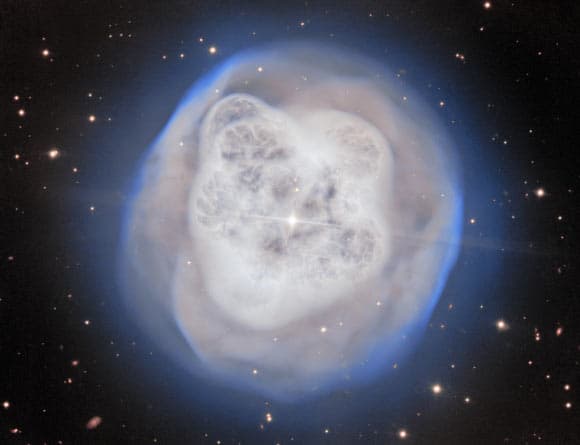
Nebulae represent the late evolutionary stages of stars, where expelled gas and dust form luminous clouds that can later seed new generations of stars. The Crystal Ball Nebula, situated several thousand light‑years away, is a classic example of this recycling process. Its intricate filaments and glowing knots are the result of stellar winds colliding with surrounding interstellar material, a phenomenon that astronomers decode through spectroscopy and high‑resolution imaging.
Gemini North, perched on Maunakea, Hawai'i, is a twin‑mirror, 8‑metre class telescope that operates primarily in the infrared and optical regimes. Unlike space‑based platforms, Gemini must contend with Earth's turbulent atmosphere, which blurs incoming light. To overcome this, the observatory employs adaptive optics (AO): a system of deformable mirrors and wave‑front sensors that measure atmospheric distortion in real time and adjust the mirror shape thousands of times per second. The result is a near‑diffraction‑limited image that rivals the sharpness of space telescopes, albeit at a fraction of the launch cost.
The recent image of the Crystal Ball Nebula showcases the maturity of AO technology. It also underscores the collaborative nature of modern astronomy, where instrument scientists, software engineers and astrophysicists converge to plan observations, calibrate instruments, and translate raw photons into scientifically useful data. This collaborative model mirrors the interdisciplinary teams that drive Nigeria's emerging tech hubs, suggesting a transferable organisational blueprint.
What happened
According to the Sci.News report, Gemini North's team targeted the Crystal Ball Nebula during a series of clear‑sky nights, employing the telescope's Near‑Infrared Imager and spectrograph (NIRI) in conjunction with its AO system. The observation sequence involved multiple exposures to increase signal‑to‑noise, followed by a rigorous calibration routine that corrected for detector artefacts, sky background and residual atmospheric effects. The final composite image reveals fine‑scale structures-bright knots, filamentary arcs and shadowed cavities-that were previously blurred in older observations.
The release generated immediate public fascination, with social media users sharing the image for its aesthetic appeal. However, the scientific community focused on the image's diagnostic power: the sharper view enables more precise measurements of gas density, temperature gradients and shock fronts within the nebula. Such parameters feed into models of stellar feedback, a key ingredient in understanding galaxy evolution. In practical terms, the data set also serves as a benchmark for testing new AO algorithms, a process that can be mirrored in Nigerian research labs seeking to refine their own imaging pipelines.
Key facts readers should know
- Adaptive optics: Gemini North's AO system corrects atmospheric turbulence up to several hundred Hertz, delivering near‑diffraction‑limited resolution in the near‑infrared.
- Instrument suite: The image was captured with NIRI, a versatile imager that operates across 1-5 µm wavelengths, allowing astronomers to probe both hot ionised gas and cooler dust components.
- Data pipeline: Raw frames undergo dark subtraction, flat‑fielding, sky subtraction and distortion correction before being stacked into the final high‑dynamic‑range picture.
- Scientific relevance: The nebula's morphology, now resolved into sub‑arcsecond features, provides constraints on the speed and composition of stellar outflows.
- Broader impact: AO technology pioneered for astronomy has been adapted for ophthalmology, laser communications and precision manufacturing.
Why this matters for Nigeria
Nigeria's ambition to become a hub for science, technology, engineering and mathematics (STEM) hinges on visible role models and tangible learning resources. The Crystal Ball Nebula image offers several pathways to reinforce that ambition:
- Curriculum enrichment - Physics and astronomy teachers can use the image to illustrate concepts such as diffraction limits, wave‑front sensing and radiative transfer, turning abstract textbook sections into concrete visual case studies.
- Research capacity building - Nigerian universities that host small‑scale observatories or collaborate on international projects can reference Gemini's AO workflow as a benchmark for developing local instrumentation programmes.
- Industry linkage - Companies in the imaging and sensor markets can trace the lineage of their core technologies back to astronomical AO, providing a narrative that justifies investment in high‑precision engineering.
- Inspiration for youth - A striking nebular picture, paired with a clear explanation of the engineering behind it, can spark curiosity among secondary‑school students, encouraging them to pursue degrees in physics, computer science or mechanical engineering.
- Policy leverage - By showcasing a high‑profile scientific achievement, policymakers can argue for sustained funding of national observatories, data‑science centres and STEM outreach, aligning with broader economic diversification goals.
These strands illustrate how a single astronomical image can become a catalyst for curriculum development, research collaboration and industrial innovation across Nigeria.
Wider African and global context
Across Africa, a network of emerging observatories-such as the South African Large Telescope (SALT) and the upcoming African Very Large Telescope (AVLT) project-are adopting AO and advanced data pipelines similar to Gemini's. These facilities aim to place the continent at the forefront of time‑domain astronomy, exoplanet detection and cosmology. The success of Gemini's AO system demonstrates that the technology is mature enough to be replicated in diverse environments, provided there is sustained funding and skilled personnel.
Globally, the trend toward ground‑based telescopes equipped with extreme‑AO (XAO) systems is reshaping the competitive landscape with space missions. Projects like the Extremely Large Telescope (ELT) and the Thirty Meter Telescope (TMT) will rely heavily on AO to achieve unprecedented resolution. The Gemini North image therefore sits within a broader narrative: Earth‑based observatories are no longer limited by atmospheric blur, and their engineering breakthroughs feed directly into sectors ranging from autonomous vehicles to quantum‑communication networks. For Nigeria, aligning national research agendas with these global trajectories can open pathways to international partnerships and technology transfer.
Expert insight and practical implications
Dr Adaeze Okonkwo, a senior lecturer in astrophysics at the University of Lagos, notes that "the Gemini North image is a textbook example of how a single observation encapsulates an entire ecosystem of engineering, software development and scientific interpretation." She adds that Nigerian students who engage with such data can acquire transferable skills in:
- Signal processing - mastering techniques for noise reduction and image reconstruction.
- Software engineering - contributing to open‑source pipelines that handle terabytes of astronomical data.
- Systems engineering - understanding the integration of optics, mechanics and control electronics.
From a policy perspective, the image underscores the importance of cross‑disciplinary funding. Investment in a high‑performance computing centre, for instance, benefits both astronomical data analysis and national initiatives in climate modelling. Likewise, supporting local fabrication of deformable mirrors could create a niche manufacturing sector, reducing reliance on imported components.
In practical terms, Nigerian tech firms could explore joint ventures with university labs to adapt AO‑derived wave‑front sensing for non‑astronomical imaging, while health‑care providers might pilot AO‑enhanced endoscopic systems that trace their lineage to the same technology used on Gemini.
What readers should watch next
The immediate scientific follow‑up will involve spectroscopic studies of the nebula's bright knots, aiming to map chemical abundances and velocity fields. For Nigerian audiences, the next steps include:
- Workshops - university physics departments may host seminars on AO fundamentals, using the Gemini image as a case study.
- Collaborative proposals - Nigerian researchers could seek partnership with Gemini or other international observatories to obtain observing time on similar targets.
- Outreach programmes - science museums and media outlets can feature the nebula in exhibitions that pair visual art with explanatory panels on adaptive optics.
- Technology‑transfer pilots - engineering faculties might launch pilot projects that adapt AO components for local industry, creating demonstrator devices for medical or agricultural imaging.
Monitoring these developments will reveal how a single astronomical image can catalyse educational programmes, research collaborations and technology‑transfer initiatives.
Frequently asked questions
What is adaptive optics and why is it important for ground‑based telescopes?
Adaptive optics (AO) is a real‑time correction system that measures atmospheric distortion using a wave‑front sensor and adjusts a deformable mirror to compensate. This restores image sharpness, allowing ground‑based telescopes to achieve resolutions comparable to space telescopes.
How does the Gemini North image differ from earlier pictures of the Crystal Ball Nebula?
Earlier images were limited by atmospheric blur, showing only broad glow and vague structure. The Gemini North image resolves sub‑arcsecond features-sharp filaments, bright knots and shadowed cavities-providing a clearer view of the nebula's internal dynamics.
Can the technology behind the image be used outside astronomy?
Yes. AO components such as wave‑front sensors and deformable mirrors are employed in ophthalmic surgery, laser communication, and precision manufacturing, where correcting optical aberrations is critical.
Why do ground‑based telescopes still matter when we have space telescopes?
Ground‑based facilities are more flexible, cheaper to upgrade and can host larger mirrors than most space missions. With AO, they can deliver comparable resolution, making them essential for long‑term monitoring and rapid response observations.
How can Nigerian students get involved in similar research?
Students can join university astronomy clubs, participate in data‑analysis workshops, or apply for summer research placements with international observatories that offer remote access to archival data.
What role does data science play in creating the final image?
Raw detector frames undergo calibration, noise filtering, alignment and stacking-processes that rely on sophisticated algorithms and high‑performance computing. Data‑science techniques ensure the final picture is scientifically reliable.
Are there plans for an African‑based telescope with adaptive optics?
Several African initiatives, including the African Very Large Telescope project, aim to incorporate AO systems. These efforts seek to bring cutting‑edge imaging capability to the continent.
How does this image help us understand stellar evolution?
By resolving fine structures within the nebula, astronomers can measure gas densities, temperatures and shock velocities, all of which inform models of how massive stars shed material and enrich the interstellar medium.
What practical benefits could Nigerian industry derive from AO technology?
Industries such as medical imaging, remote sensing and high‑speed communications can adopt AO‑derived wave‑front correction to improve image clarity, signal fidelity and manufacturing tolerances, potentially boosting competitiveness.
How might government policy support the translation of astronomical tech to local applications?
Policies that fund interdisciplinary research centres, incentivise local component manufacturing and promote public‑private partnerships can create an ecosystem where astronomical innovations are repurposed for health, agriculture and security sectors.
Conclusion
The Gemini North telescope's crystal‑clear view of the Crystal Ball Nebula is a reminder that scientific curiosity, when paired with engineering ingenuity, produces outcomes far beyond the immediate subject of study. The image itself dazzles, but the underlying story-adaptive optics, data pipelines and interdisciplinary collaboration-offers a template for how Nigeria can nurture a robust STEM ecosystem. By leveraging such high‑profile discoveries for curriculum development, research partnerships and technology transfer, the nation can turn awe into actionable progress, ensuring that the next generation of Nigerian innovators looks up at the stars and sees a pathway to tangible advancement.
No comments yet. Be the first to spark the conversation.