Apple has just reported its best March quarter in company history - and the numbers are remarkable by any measure.
On Thursday 30 April 2026, the Cupertino tech giant posted revenue of $111.2 billion for its fiscal second quarter ended 28 March 2026, up 17% year-on-year. Net profit came in at $29.58 billion. Earnings per share hit $2.01, up 22% - beating Wall Street's forecast of $1.95. Services hit an all-time record. iPhone hit a March quarter record. And the company announced a fresh $100 billion share buyback, signalling supreme confidence in its own future.
For a company that already generates more profit per quarter than most countries produce in GDP per year, this was not just a good quarter. It was a statement.
The Full Q2 2026 Numbers at a Glance
| Segment | Revenue | Year-on-Year Change |
|---|---|---|
| Total Revenue | $111.2 billion | +17% |
| iPhone | $56.99 billion | +22% |
| Services | $30.98 billion | +16% |
| Mac | $8.4 billion | - |
| iPad | $6.91 billion | - |
| Wearables, Home & Accessories | $7.9 billion | - |
| Net Profit | $29.58 billion | - |
| EPS (Diluted) | $2.01 | +22% |
| Gross Margin | 49.3% | - |
| Operating Cash Flow | $28+ billion | March quarter record |
Wall Street had forecast revenue of $109.66 billion. Apple beat it by $1.54 billion. The quarter represents the strongest March period in the company's 50-year history.
iPhone 17: The Product That Carried the Quarter
The iPhone 17 lineup is, in Tim Cook's words, "the most popular lineup in our history." That is not marketing language. The numbers support it.
 The iPhone 17 lineup, including the new iPhone 17e, drove a 22% year-on-year surge in Apple's March quarter iPhone revenue to $56.99 billion. Image: MacRumors
iPhone revenue of $56.99 billion represented a 22% jump year-on-year and a March quarter record. Cook attributed the surge to "extraordinary demand for the iPhone 17 lineup," and CFO Kevan Parekh confirmed Apple believes it gained market share during the quarter.
Two specific additions to the lineup contributed materially to the quarter's performance. The iPhone 17e - a more affordable entry into the iPhone ecosystem, priced at $599 with MagSafe and an A19 chip - expanded Apple's addressable market downward, capturing buyers who previously chose Android or held onto older iPhones longer. The MacBook Neo, a new laptop described as "captivating customers all around the world" by Cook, also contributed to the Mac segment's revenue of $8.4 billion.
For Nigerian consumers, the iPhone 17e is particularly relevant. At $599 (approximately â¦820,000 at current exchange rates), it sits significantly below the flagship iPhone 17 Pro pricing while retaining the core Apple ecosystem experience. Whether Apple's premium pricing translates into Nigerian market share gains remains constrained by purchasing power realities, but the 17e is the most accessible iPhone ever made.
Services: Apple's Most Profitable Engine Hits Another Record
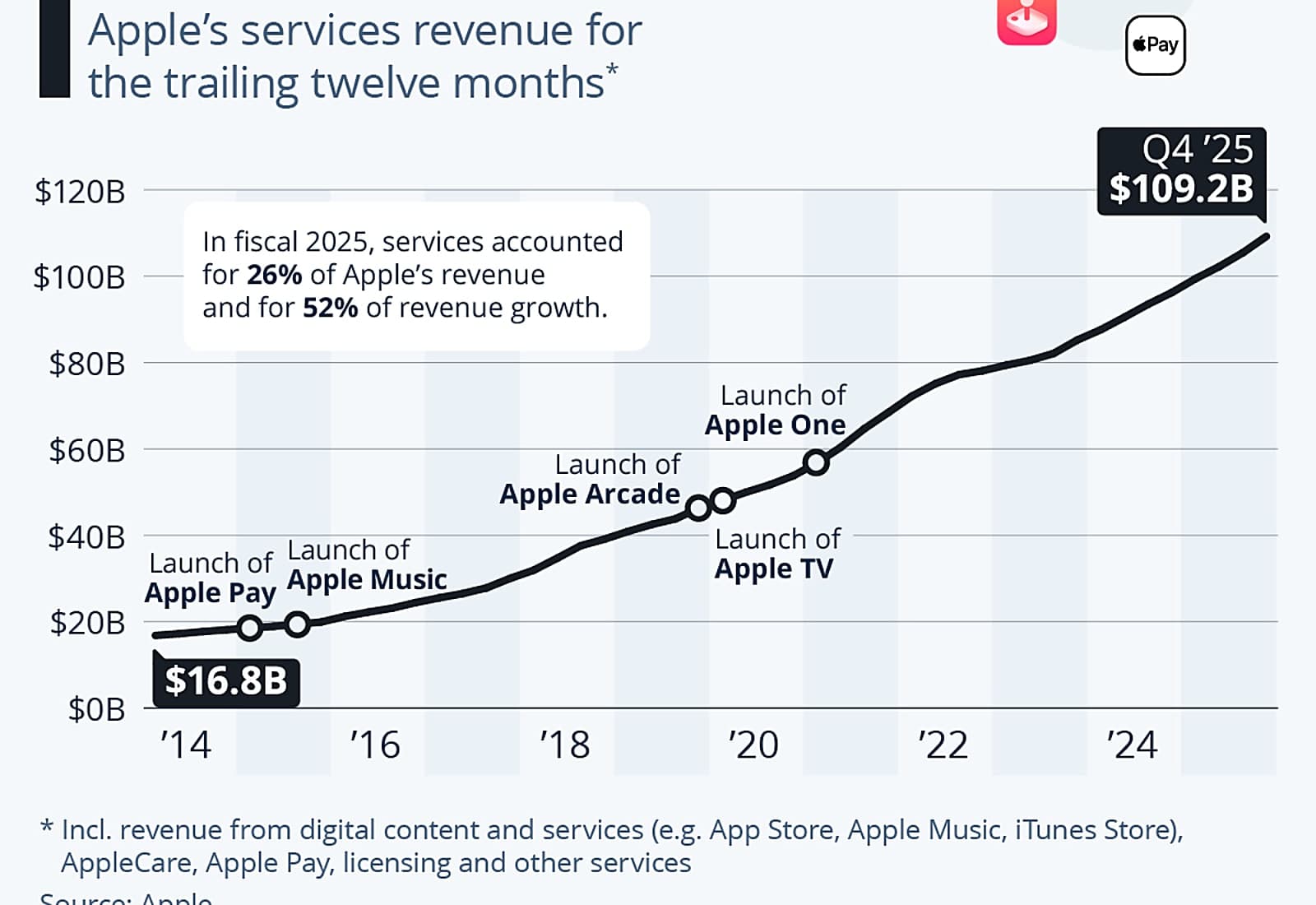
Apple's Services segment - comprising the App Store, Apple Music, Apple TV+, iCloud, Apple Pay, and a growing portfolio of subscription revenue streams - reached $30.98 billion in Q2 2026, a new all-time record.
Apple's Services segment has grown from a supplementary business line into one of the world's most profitable subscription ecosystems. Image: Statista
That $30.98 billion figure is significant for three reasons. First, it is a higher-margin business than hardware: software and subscriptions carry gross margins well above 70%, compared to approximately 38% for iPhone. Second, it is recurring - once customers are inside the Apple ecosystem, subscription revenue compounds annually. Third, it is growing at 16% year-on-year even from an already enormous base.
For context, $30.98 billion in a single quarter means Apple's Services division alone is generating revenue at an annualised rate of approximately $124 billion - larger than most Fortune 500 companies' total annual turnover.
The active device installed base hit a new all-time high across all major product categories and geographic segments during the quarter. More devices in use means more potential Services subscribers, which means the revenue ceiling for this segment continues to rise.
The $100 Billion Share Buyback: What It Means
Alongside the earnings report, Apple announced a new $100 billion share buyback programme. This is Apple's way of returning value to shareholders: the company uses its cash to purchase its own shares from the open market, reducing the total number of shares outstanding and thereby increasing the value of each remaining share.
For investors, a $100 billion buyback from a company generating $28 billion in operating cash flow in a single quarter is not surprising. Apple has been the most prolific buyback executor in corporate history, having returned well over $600 billion to shareholders through buybacks over the past decade.
What the buyback signals is Apple's internal confidence: the board believes the company's own shares are undervalued relative to its future earnings power and is willing to deploy that cash accordingly. In a global environment of economic uncertainty and tariff pressures, that confidence statement carries its own significance.
What Apple Said About Tariffs
One of the most closely watched aspects of the Q2 earnings call was how Apple addressed the ongoing US tariff environment, which affects its manufacturing supply chain centred in China, India, and Vietnam.
Cook acknowledged the tariff uncertainty directly but declined to provide a formal long-term guidance update, noting the situation remains fluid. He did note that Apple has been diversifying its manufacturing footprint: a significant portion of iPhone production has moved to India, which carries lower tariff exposure than Chinese manufacturing under current US trade policy.
Apple did not quantify the tariff impact on Q2 results explicitly. The company's ability to post 17% revenue growth in this environment suggests its supply chain diversification has so far insulated earnings from the worst-case tariff scenarios that analysts feared at the start of 2026.
What This Means for the Nigerian Tech Market
Apple's Nigerian presence is growing, though it remains limited by pricing and distribution compared to markets with local Apple Stores.
The iPhone 17e's $599 price point is the most significant development for Nigerian consumers in this earnings cycle. Premium Nigerian earners, diaspora returnees, and tech professionals have consistently driven Apple's grey market presence in Lagos and Abuja. The 17e creates a lower entry point without sacrificing the ecosystem experience, and if Slot, iStore, and other Nigerian Apple-authorised resellers price it competitively, it could meaningfully expand Apple's Nigerian customer base.
For Nigerian tech investors and startup founders tracking global tech health, Apple's $111.2 billion quarter matters as a signal: consumer tech demand is robust globally, premium pricing is holding, and the shift toward services-based recurring revenue is accelerating. These trends shape the global digital environment in which Nigerian tech companies and consumers operate.
The New MacBook Neo and iPad Air M4
Two additional product launches during the quarter deserve mention:
The MacBook Neo, part of Apple's 2026 laptop lineup powered by M-series chips, has been described by Tim Cook as "captivating customers all around the world." Image: Geeky Gadgets
The MacBook Neo is Apple's newest laptop addition, positioned in the lineup alongside the MacBook Air and MacBook Pro. Cook specifically cited it as a standout product driving Mac revenue during the quarter. Full specifications and positioning details have been extensively covered in tech media, but its contribution to Mac's $8.4 billion quarter is clear.
The iPad Air M4 rounds out the product launches for the quarter, continuing Apple's practice of applying its latest silicon to the mid-range iPad lineup. The M4 chip in iPad Air brings desktop-class performance to a form factor that competes directly with standalone laptops in many professional use cases.
Common Misconceptions About Apple's Earnings
"Apple is just an iPhone company." iPhone contributes significantly, but Services alone generated nearly $31 billion this quarter. At current growth rates, Services will surpass iPhone revenue within a few years.
"Apple's best days are behind it." This quarter - the best March quarter in company history - happened 49 years after Apple was founded and 19 years after the first iPhone. The installed base continues to grow. The ecosystem continues to deepen.
"Tariffs will destroy Apple's margins." Q2 gross margin came in at 49.3%. For a hardware company facing tariff uncertainty and supply chain complexity, a margin approaching 50% is exceptional. Apple's pricing power and supply chain management continue to absorb external pressures better than most analysts projected.
Conclusion
Apple's Q2 2026 results are a masterclass in what a mature technology platform looks like when it is firing on all cylinders. Revenue of $111.2 billion. Net profit of $29.58 billion. Services and iPhone both at all-time March quarter records. A $100 billion buyback. And a CEO who described it simply as "our best March quarter ever."
In a global economy navigating tariff uncertainty, geopolitical instability, and inflationary pressure, Apple posted 17% revenue growth and 22% earnings per share growth. That is not luck or momentum. It is the product of a platform, an ecosystem, and a brand that has made switching costs so high that most of its customers will never leave willingly.
The next quarter begins now. And Apple enters it from a position of historic strength.
All financial figures sourced directly from Apple's official Q2 2026 earnings release (SEC Form 8-K), Apple Newsroom, MacRumors, 9to5Mac, and Yahoo Finance. All data correct as of 30 April 2026.
No comments yet. Be the first to spark the conversation.