On Thursday, 14 May 2026, a company that most people outside the technology world had never heard of walked onto the Nasdaq stock exchange and raised $5.55 billion in a single day.
Cerebras Systems, a San Francisco-based AI chip designer, priced its shares at $185 the night before trading. The stock opened at $350, nearly double the IPO price, and at one point hit $385 during its first session. By the close of trading, shares settled at $311.07, representing a 68% gain on its opening day.
It was the largest technology IPO in the United States since Snowflake debuted in 2020. And for the artificial intelligence industry, it was something more significant than a stock market milestone. It was a signal.
What Does Cerebras Actually Do?
To understand why investors are this excited, you need to understand what Cerebras makes and why it is different.
The dominant chip in AI computing today is the GPU, the graphics processing unit, most famously produced by Nvidia. These chips were originally designed for video gaming but turned out to be remarkably well-suited to the kind of parallel processing AI models require. Nvidia has built a business worth trillions of dollars on the back of this coincidence.
Cerebras took a different approach.
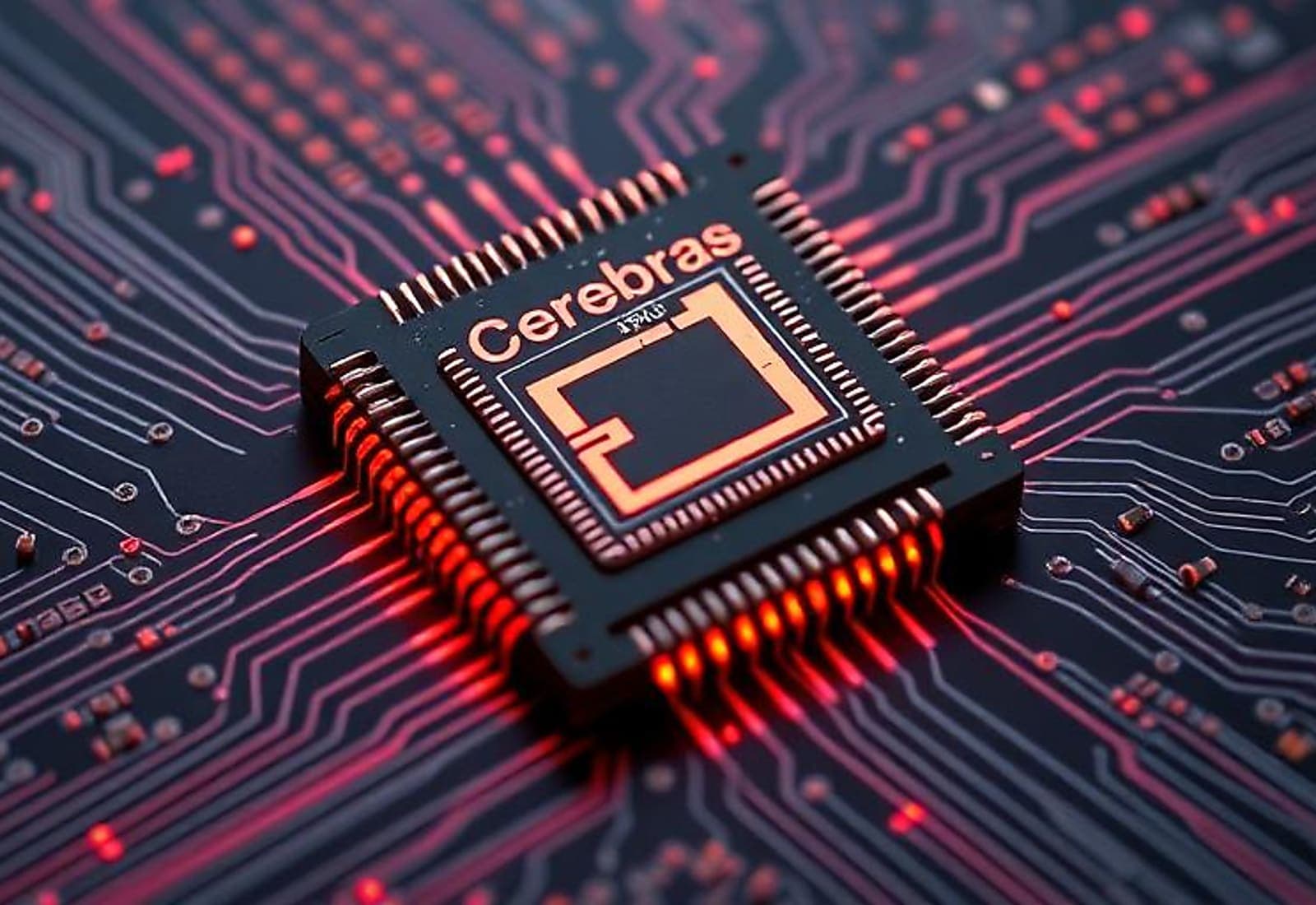
Its flagship product, the Wafer Scale Engine 3, is built on a single silicon wafer. Most chips are cut from silicon wafers into smaller pieces. Cerebras uses the entire wafer as one chip. The result is a processor roughly the size of a dinner plate, as the company's CEO Andrew Feldman described it, with approximately four trillion transistors and 900,000 processing cores.
The practical implication: Cerebras chips are significantly faster than Nvidia GPUs at AI inference, which is the process of actually running a trained AI model when a user interacts with it. Every time someone uses ChatGPT, asks Claude a question, or runs an AI application, inference is what is happening. And inference is the fastest-growing segment of the AI market.
Feldman made the case plainly in an interview with Fortune: "If you ask Anthropic, if you ask OpenAI, they have vastly more demand for their offering than they have compute to make it. And that is a profoundly different scenario" from speculative investment. The demand is real. The constraint is hardware. Cerebras is positioning itself to ease that constraint.
The Numbers Behind the Hype
The financial profile of Cerebras is a study in contradictions that are perfectly normal for a high-growth technology company.
Revenue has grown explosively: from $24.6 million in 2022 to $78.7 million in 2023, $290.3 million in 2024, and $510 million in 2025. That represents a more than twentyfold increase in three years.
The company still posts operating losses, which is common for businesses reinvesting heavily in research and development at this stage. But the forward revenue picture is what has investors most excited. Cerebras reported a remaining performance obligation of $24.6 billion in contractually committed but not yet recognised revenue. That figure is roughly 48 times its full-year 2025 sales. In simple terms, the business already has nearly $25 billion worth of future revenue locked in through signed contracts.
In early 2026, Cerebras signed a $20 billion deal with OpenAI. Amazon Web Services announced a partnership to offer the Wafer Scale Engine to cloud customers, with Amazon purchasing approximately $270 million in Cerebras stock as part of the arrangement. Customers now include OpenAI, Amazon, and Meta Platforms.
Institutional investors clearly found those numbers compelling. Demand for the IPO exceeded available shares by more than 20 times, forcing the company to raise both its price range and share count twice during the roadshow. Total US IPO proceeds in 2026 have more than doubled year-to-date to $22.3 billion. Cerebras alone accounts for roughly a quarter of that total.
Why This IPO Matters Beyond Wall Street
The Cerebras debut is not just a story about one company's stock market performance. It is a data point in the broader question of whether the AI infrastructure investment cycle is real or inflated.
The answer, based on this IPO, appears to be: real.
Companies building AI products face a genuine constraint: they cannot get enough computing power to meet user demand. That is a hardware problem. Solving it requires companies like Cerebras, Nvidia, and others to build chips faster than demand grows. When a company enters the public market with $24.6 billion in committed future revenue and sees its shares double on the first day, that tells you something about the scale of unsatisfied demand for AI infrastructure.
Later in 2026, IPOs from SpaceX and OpenAI are expected. Together, they are projected to raise a combined $135 billion. The Cerebras IPO is being watched as a litmus test for whether public market investors have the appetite for that scale of AI-related listing. Based on Thursday's performance, the answer appears to be yes.
The Risks Worth Understanding
No article about an IPO that surged 68% on its first day should ignore the risks. There are several worth knowing.
Customer concentration remains high. In 2025, 86% of Cerebras' revenue came from just two UAE-linked customers: G42 and the Mohamed bin Zayed University of Artificial Intelligence. The $20 billion OpenAI deal and the Amazon partnership are expected to diversify this base significantly. But until those contracts generate substantial recognised revenue, the dependence on a small number of large clients is a structural vulnerability.
The valuation is aggressive. At its closing price on day one, Cerebras traded at more than 130 times its 2025 sales. For comparison, Nvidia, one of the most successful companies in the history of the semiconductor industry, trades at a significantly lower multiple. A stock priced this richly requires a very long runway of high growth to justify itself.
Competition is intense. Nvidia is not standing still. AMD is investing in AI chips. Google has its own TPU processors. Intel is attempting a comeback. Cerebras has a genuine technical advantage in inference speed, but technology advantages in semiconductors do not remain exclusive for long.
IPO history offers a cautionary note. Research from Jay Ritter, a finance professor at the University of Florida who has tracked IPO returns since 1980, shows that newly public companies have underperformed similar-sized firms by an average of roughly 3.6% per year during their first five years. For major IPOs since 2010, the first-year underperformance gap has been closer to nine percentage points. Excitement on day one does not guarantee strong returns over the following years.
What This Means for Nigerians and African Tech
For most Nigerians, Cerebras stock is not directly accessible without a foreign brokerage account. But the broader story matters.
Nigeria's technology ecosystem, from Lagos fintech companies to Abuja-based startups, increasingly depends on AI tools. Those tools run on inference hardware. As companies like Cerebras scale up supply and bring competition to Nvidia's near-monopoly position, the cost of running AI models should fall over time. Lower inference costs mean more accessible AI tools for African developers building on top of those systems.
The broader point is that the AI infrastructure layer, the chips, the data centres, the compute networks, is where a significant portion of value is being created and captured right now. Understanding these dynamics helps Nigerian entrepreneurs, investors, and technology professionals make better decisions about where to focus attention and resources in the years ahead.
Common Misconceptions to Clear Up
"Cerebras is a direct competitor trying to replace Nvidia." Cerebras competes with Nvidia specifically in AI inference, not in all computing categories. Nvidia remains dominant in AI training and has a much broader product range. Cerebras is carving out a specific niche, not attempting a wholesale takeover of the semiconductor market.
"A 68% IPO pop means the stock will keep rising." History suggests otherwise. Strong opening day performance frequently reflects the deliberate underpricing of IPO shares to generate excitement. Long-term returns depend on business fundamentals, not opening day momentum.
"This IPO means AI is a bubble that will burst." The fact that investors are willing to pay high multiples does not by itself indicate a bubble. Bubbles involve speculation disconnected from underlying demand. Cerebras has $24.6 billion in committed contracts and a customer list that includes OpenAI, Amazon, and Meta. The demand underpinning these valuations is genuine, even if the pricing is aggressive.
Conclusion
The Cerebras IPO is one of the most significant events in the technology industry so far in 2026. It tells a story about genuine, unsatisfied demand for AI computing power, about investors willing to pay extraordinary premiums to access that growth, and about a company that built a genuinely different approach to chip design and persuaded some of the world's most important technology companies to back it with billions in committed spending.
Whether Cerebras lives up to its opening day valuation over the next three to five years is a question only time will answer. What is not in question is the scale of the opportunity it is chasing.
The AI chip race is real. It is happening now. And Cerebras just told the world it intends to win a very large part of it.
No comments yet. Be the first to spark the conversation.