Introduction
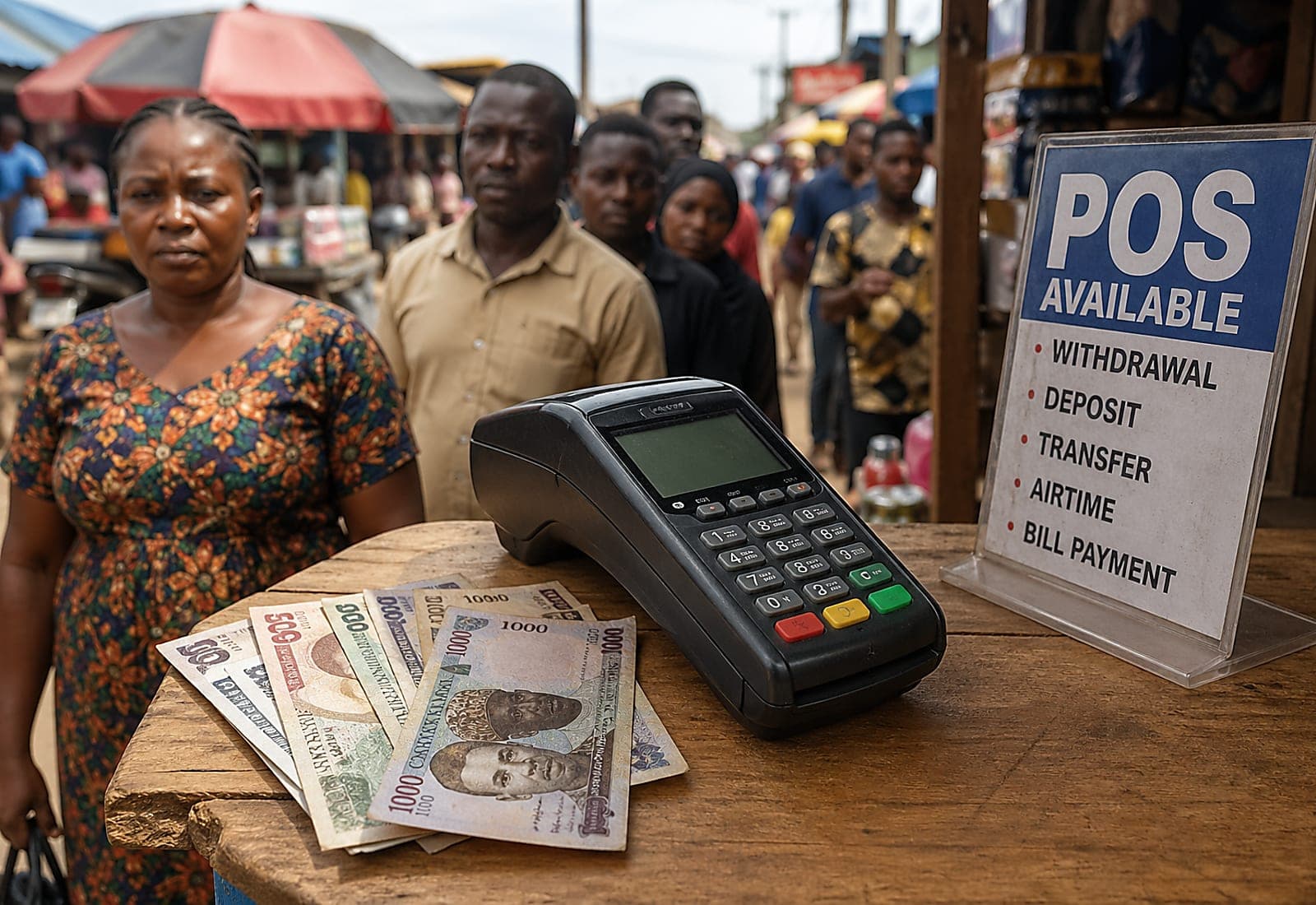
Walk through any busy Nigerian market, motor park, or residential street and you will find one thing everywhere, a POS stand. What looks like a simple service table is quietly generating thousands of naira daily for the people behind those machines.
The POS business remains one of Nigeria's most accessible income streams. You do not need a degree, a big office, or powerful connections to start. However, you do need the right information, because without it, many new operators make avoidable mistakes that eat into their profits from day one.
This guide explains exactly how to start a POS business in Nigeria in 2026: what it costs, what documents you need, how to choose your provider, where to locate your stand, and how to grow beyond one machine.
Why the POS Business Still Makes Sense in 2026
Despite the rise of mobile banking apps, millions of Nigerians still rely on physical cash. ATM queues remain long, and bank branches are scarce in many communities. POS agents fill that gap, and they get paid for it.
Agent banking has become a core part of Nigeria's financial infrastructure, particularly in underserved areas where traditional banks have no presence. This is not a saturated market opportunity, it is a growing demand.
- Minimum startup capital: From ₦100,000
- Typical daily earnings: ₦10,000 to ₦30,000 per machine
- Scalability: Operators can run 5 to 10 units across multiple locations
What You Need to Start, Documents and Requirements
Before you apply for a POS machine, gather the following:
- Valid government-issued ID (NIN slip, National ID card, or passport)
- Bank Verification Number (BVN)
- Two recent passport photographs
- Proof of address (utility bill or tenancy agreement)
- CAC business registration certificate (required by most providers)
- A physical location, kiosk, shop, or market stall
- Working capital (your float)
2026 Update: Nigeria's tax reforms took effect in January 2026. POS operators are now required to have a Tax ID and, ideally, a dedicated business account. Mixing personal and business funds can lead to inflated tax assessments, so register properly from the start.
How Much Does It Cost to Start a POS Business in Nigeria?
Your total startup cost depends on your location, provider choice, and whether you operate from a fixed kiosk or move around. Here is a realistic budget breakdown:
| Item | Estimated Cost |
|---|---|
| POS machine (subsidised by most fintechs) | ₦20,000 to ₦35,000 |
| CAC business registration | ₦10,000 to ₦20,000 |
| Starting float (working capital) | ₦50,000 to ₦200,000 |
| Kiosk, signage, and setup | ₦10,000 to ₦30,000 |
| Data and miscellaneous costs | ₦5,000 to ₦15,000 |
| Total estimate | ₦95,000 to ₦300,000 |
Some fintechs and banks offer free or heavily subsidised machines. However, free machines often come with higher transaction targets, so weigh that trade-off before choosing.
Step-by-Step: How to Start Your POS Business
Step 1, Research Your Area
Before spending a naira, observe your environment. How many POS stands already operate nearby? How busy are they? Areas with strong foot traffic but limited ATM or bank access are ideal, such as markets, junctions, motor parks, and residential streets.
Step 2, Choose Your Business Model
You can operate as an independent agent, where you manage your own machine and keep all profits but handle all risks, or work under an aggregator who provides support in exchange for a commission split. Beginners often benefit from starting under an aggregator.
Step 3, Register Your Business with CAC
This step is now essential with most providers. A registered business name builds trust, as customers feel safer transacting with a recognised business.
Step 4, Choose a POS Provider
Moniepoint and OPay dominate the Nigerian agent banking market and are known for fast onboarding and reliability. Banks such as First Bank and Access Bank also offer POS terminals but often have stricter requirements.
Choose based on network strength in your specific area, not just reputation.
Step 5, Apply and Get Your Machine
Submit your documents to your chosen provider. Fintech companies typically process applications faster than traditional banks. Once approved, complete any required training and collect your terminal.
Step 6, Set Up Your Float and Start Operating
Your float is the cash used to serve customers. A low float can force you to turn customers away, which means lost income. Start with at least ₦50,000 and replenish consistently.
Practical Example: Daily Operations
Consider Amaka, who started her POS stand at a busy junction in Ojota, Lagos, with ₦150,000 in capital. She handles 40 to 60 transactions daily, including withdrawals, transfers, and airtime purchases.
By charging small fees per transaction, she earns between ₦12,000 and ₦18,000 daily. On busy days, such as salary periods, her earnings increase significantly.
After three months, she expanded by adding a second machine and hiring an attendant. Her initial investment was recovered within six weeks.
Common Mistakes to Avoid
Choosing location based on rent instead of traffic A cheap location without customers results in losses.
Starting with a low float Running out of cash reduces transactions and damages customer trust.
Ignoring network reliability Poor network leads to failed transactions and frustrated customers.
Not keeping records Without tracking income and expenses, profitability becomes unclear.
Not verifying transactions before releasing cash Always confirm successful transactions on your POS device.
Operating without proper registration Non-compliance can result in penalties and loss of your POS terminal.
Expert Tips to Maximise Profit
- Use two POS machines from different providers to avoid downtime
- Offer additional services such as airtime, bill payments, and data subscriptions
- Maintain a clean and professional setup to build customer trust
- Keep accurate records of all transactions
- Expand only when your first location is stable and profitable
- Use a dedicated business account for better financial management
Conclusion
The POS business in Nigeria is not glamorous, but it is profitable, scalable, and accessible. In 2026, success depends less on shortcuts and more on doing the basics correctly.
Choose the right location, maintain a strong float, register your business, use a reliable provider, and track your finances consistently.
The machine is just a tool, the real business is built by the operator.
No comments yet. Be the first to spark the conversation.