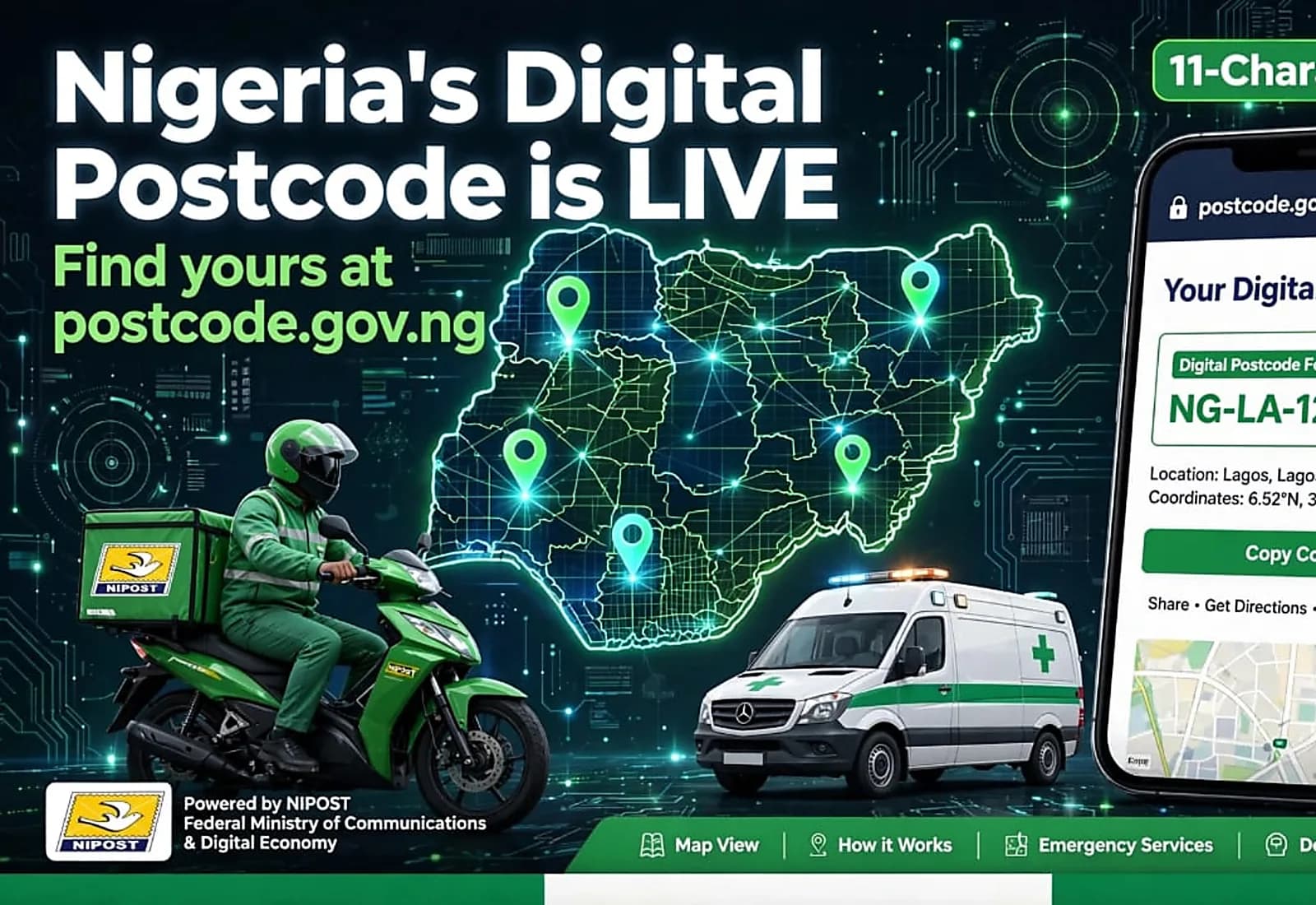
Nigeria has a new way to identify buildings and locations.
The Federal Government officially launched the National Digital Alphanumeric Postcode System on Thursday, October 1, 2026, through the Nigerian Postal Service (NIPOST).
The system gives addressable buildings across Nigeria a unique 11-character alphanumeric postcode linked to their geographic location.
Unlike the conventional postcode system, the new digital system is designed to identify locations at building level using Geographic Information System (GIS) technology.
NIPOST has made the system available online, allowing Nigerians to find, save and share the postcode assigned to their homes, offices, businesses and other locations.
The launch is part of the government's wider effort to strengthen Nigeria's digital addressing infrastructure and create a standard location reference that can be used by individuals, businesses, government agencies and technology platforms.
But what exactly is the new Digital Postcode, and what should Nigerians do with theirs?
What Is Nigeria's New Digital Postcode?
A Digital Postcode is an 11-character code assigned to an addressable building in Nigeria.
The code belongs to the building rather than the individual living or working there.
That means several people or organisations using the same building can use the same postcode. If someone moves to another building, they will use the postcode associated with the new location.
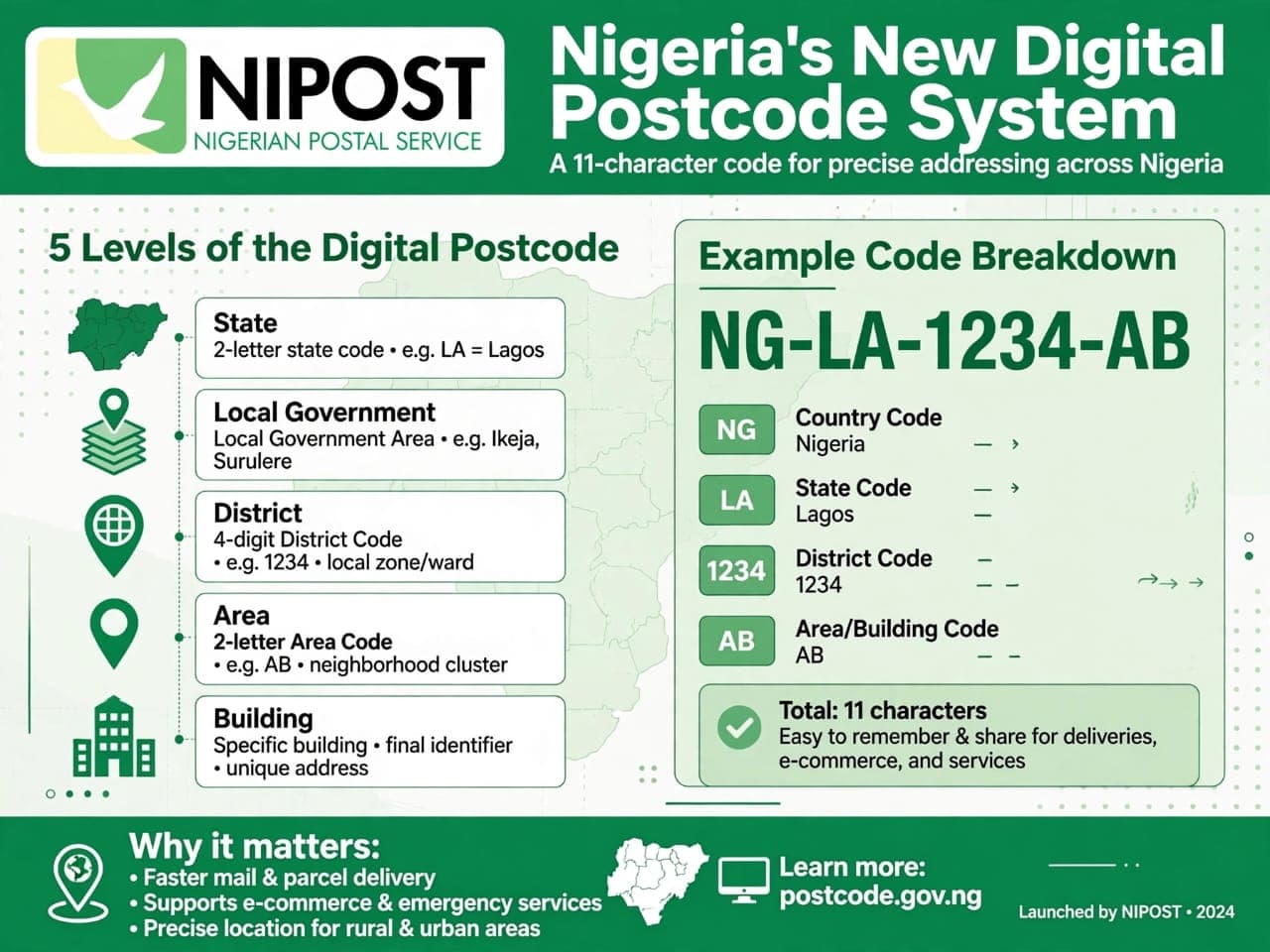
The system identifies locations through five levels:
- State
- Local Government Area
- District
- Area
- Building
The official NIPOST platform gives an example of the structure as FC 02 A09 DB 09, with the different sections representing the different geographic levels.
The system covers Nigeria's 36 states and the Federal Capital Territory.
The idea is to give each addressable building a standard digital reference rather than relying entirely on descriptions involving landmarks, junctions or nearby buildings.
Is It the Same as Your Normal Address?
No.
Your Digital Postcode does not replace your normal address.
Your house number, street, estate, town, Local Government Area and other address details remain relevant.
The Digital Postcode provides an additional standard reference for the location.
NIPOST's official FAQ explains that the postcode and an address are different things and can be used together.
For example, someone ordering a package could provide their usual address and add the Digital Postcode as another way of identifying the building.
This could be useful where an address is difficult to locate or where several buildings have similar descriptions.
How Can You Find Your Digital Postcode?
NIPOST has created an official platform for Nigerians to search for their postcodes.
The service is available at postcode.gov.ng.
Users can search for their building or location. The platform can also use location access to help identify the building where the user is currently located.
The official website also provides access to the NIPOST Postcode app, which allows users to find, save and share postcodes.
Individuals can find, save and share their Digital Postcodes for free.
That means Nigerians do not need to pay an unofficial agent simply to obtain a postcode.
The safest option is to use the official NIPOST platform rather than links from unknown websites or social media accounts.
What If Your Building Is Not Showing?
The launch of the system does not mean every building record will necessarily be perfect immediately.
NIPOST has provided a process for people whose buildings cannot be found or whose information is incorrect.
According to the official FAQ, a user can request a postcode through the Digital Postcode website or app. The user can provide an address, a Google Maps link or use their current location to help identify the building.
NIPOST can then review the request and assign a postcode to the building.
Users can also suggest an edit if information connected to a building is incorrect or needs to be updated.
This is an important feature because a location system is only useful when the underlying information is accurate.
What Can You Use the Digital Postcode For?
One of the simplest uses is sharing your location.
Instead of repeatedly explaining how someone should find your home, office or business, you can share the Digital Postcode as a standard reference for the building.
NIPOST says users can share their postcode with friends, family, customers, delivery services and other people who need to identify the location.
The NIPOST platform also provides instructions for sharing a postcode directly from its app.
For example, a person can find the correct building, select the postcode and share it through a messaging or social media application.
The postcode can also be saved for places that are used frequently.
That could include your home, office, shop, parents' house or another location that you regularly need to share.
How Could It Help Online Businesses?
The new system could be particularly relevant to businesses that depend on physical deliveries.
An online seller may receive an order from a customer whose address is difficult for a delivery company to locate.
The business might have to request additional directions, landmarks, a map pin or a phone call with the customer.
A building-level Digital Postcode gives the business another standard piece of location information.
NIPOST says organisations can integrate Digital Postcode into their own applications, websites and workflows.
The official platform allows organisations to verify customer and merchant addresses, look up building postcodes and integrate the system using its available API, web and mobile software development tools and bulk access options.
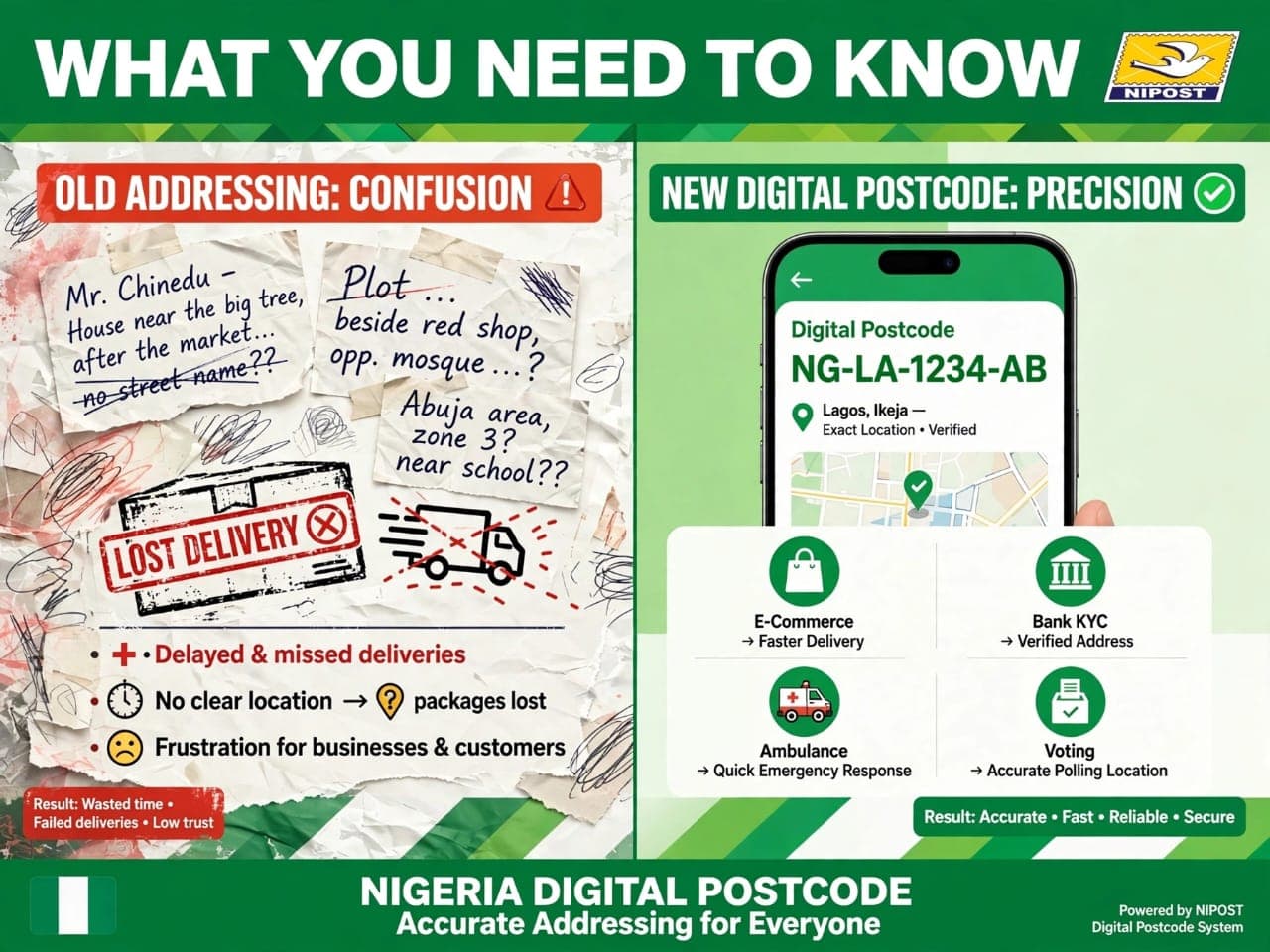
This could make the system relevant to businesses involved in:
- E-commerce
- Logistics
- Retail
- Banking
- Insurance
- Real estate
- Hospitality
- Delivery services
However, businesses still need to adopt and integrate the system before customers can expect every service to recognise a Digital Postcode.
Could It Help Emergency Services?
Emergency response is another area identified by the government and NIPOST.
The Federal Ministry of Communications, Innovation and Digital Economy says accurate location information could support emergency response and the delivery of essential public services.
The basic idea is straightforward.
When someone needs urgent assistance, being able to identify the correct location quickly can be important.
A standard digital location reference could potentially make it easier for an emergency service or another organisation to identify a building.
However, Nigerians should distinguish between what the system is designed to support and what every emergency agency is already using today.
The launch does not mean that all emergency services across Nigeria have immediately integrated the new postcode into their operations.
That will depend on adoption and integration by individual agencies and service providers.
Does It Replace Google Maps?
No.
NIPOST specifically states that the Digital Postcode does not replace Google Maps or other navigation services.
The postcode provides a standard reference for identifying a building, while mapping applications can still be used for navigation and directions.
In practical terms, Nigerians may eventually use both.
A person can provide a postcode to identify the destination and still use a mapping application to determine how to get there.
What Does It Mean for Businesses?
Businesses may eventually have more reason to include Digital Postcodes in their customer and location records.
The government is already encouraging businesses and developers to build around the system.
On October 2, Minister of Communications, Innovation and Digital Economy Bosun Tijani said the ministry would work with NIPOST, government agencies, businesses and the technology community to integrate the postcode system into existing products and services.
The government has also made an API available for organisations that want to integrate the system into their platforms.
Potential applications mentioned by officials include commerce, transportation, healthcare, agriculture, emergency response and community services.
Again, these are potential applications and areas for integration, not a statement that every one of these services is already using the postcode nationwide.
Why the Government Is Pushing the System
The government has presented the Digital Postcode as part of Nigeria's broader digital public infrastructure.
The Federal Ministry of Communications, Innovation and Digital Economy says accurate location data can support commerce, logistics, emergency response, financial services and public-service delivery.
The minister has also linked the project to the government's broader digital-economy ambitions.
NIPOST has highlighted problems associated with Nigeria's traditional reliance on landmarks and verbal directions, particularly for deliveries, businesses and emergency services.
Channels Television reported the minister's estimate that Nigeria loses between ₦50 billion and ₦80 billion annually through missed and failed deliveries associated with poor addressing. This is a government estimate, not an independently established figure, and should be understood as such.
The Digital Postcode is intended to address part of that location problem by giving buildings a common digital identifier.
What Nigerians Should Do Now
For individuals, the first step is simple: check your building's Digital Postcode.
Go to the official NIPOST Digital Postcode platform and search for your location.
If the correct building appears, save the postcode somewhere convenient.
You can also share it with family members, customers, friends or delivery services who may need to identify your location.
If the building cannot be found, NIPOST provides a process for requesting a postcode.
If the information is incorrect, users can also submit corrections through the system.
It is worth checking the building carefully before sharing the code. Since the postcode identifies a particular building, selecting the wrong building could result in sharing the wrong location.
What Happens Next?
The launch is only the beginning of the system's wider adoption.
For the Digital Postcode to become part of everyday transactions, businesses, technology companies and government agencies will need to integrate it into their own services.
That process is already beginning.
The government is encouraging developers and businesses to build applications around the postcode, while NIPOST has provided technical options for organisations that want to integrate it into their platforms.
There will also likely be a period of adjustment as users become familiar with the codes and report locations that need corrections.
For individuals, however, there is little reason to wait.
The system is now live.
Nigeria officially launched its National Digital Alphanumeric Postcode System on October 1, 2026, giving addressable buildings a new 11-character digital location reference.
It does not replace your normal address or your navigation app.
Instead, it gives Nigerians another way to identify and share exactly where a building is.
As businesses and public services begin adopting the system, that simple code could become increasingly useful for everything from receiving a package to providing a location during an emergency.
For now, the easiest place to start is by finding your own.
Find your postcode: Official NIPOST Digital Postcode website https://postcode.gov.ng/
Sources NIPOST Digital Postcode FAQ https://www.postcode.gov.ng/faq
Federal Ministry of Communications - official launch announcement https://fmcide.gov.ng/federal-government-launches-national-digital-alphanumeric-postcode-system/
PUNCH - independent news report https://punchng.com/find-use-new-digital-postcodes-fg-urges-nigerians/
TheCable - independent news report https://www.thecable.ng/fg-launches-digital-postcode-system-to-improve-business-emergency-services/
Nigeria's New Digital Postcode Is Live: How to Find Yours and What You Need to Know matters because Nigeria stories often affect public trust, institutional credibility, and the way readers interpret wider national decisions. The deeper value comes from understanding what may change after the first burst of reaction.
The next meaningful updates around Nigeria's New Digital Postcode Is Live: How to Find Yours and What You Need to Know will usually come from official statements, confirmed follow-up reporting, and the practical response of the people or institutions involved. Readers should watch for what changes after the first reactions, not just the first reactions themselves.
What is this nigeria article about?
Nigeria has launched a new National Digital Alphanumeric Postcode System that gives addressable buildings an 11-character digital location code. Here is how the new system works, how to find yours and what Nigerians and businesses can use it for.
Why does this story matter?
Nigeria's New Digital Postcode Is Live: How to Find Yours and What You Need to Know matters because Nigeria stories often affect public trust, institutional credibility, and the way readers interpret wider national decisions. The deeper value comes from understanding what may change after the first burst of reaction.
When was this article published or updated?
It was published on 3 October 2026 and last updated on 3 October 2026.
Does this page include source references?
Not yet. This page currently relies on the published article body and available editorial context.
Where can readers find related Century Blog coverage?
Readers can continue with related coverage in the same topic area, including Oyo Monarchs Call for Federal Military Base Amid Growing Insecurity and Mass School Kidnappings Reach Nigeria's South‑West: Security, Education and Economic Implications.
No comments yet.